
Service to America
This article was originally published in the May 2025 issue of The Separationist.
On September 10, 2014 Joe Blushtein was cleaning fish at the back of a boat as it headed back towards Marina del Rey from a day of fishing off the Channel Islands, west of Los Angeles, California. His brother Igor was driving the boat and the other passengers were sleeping. Joe dipped a bucket off the side to get some water just when the boat rolled slightly. He lost his balance and fell overboard. No one noticed.
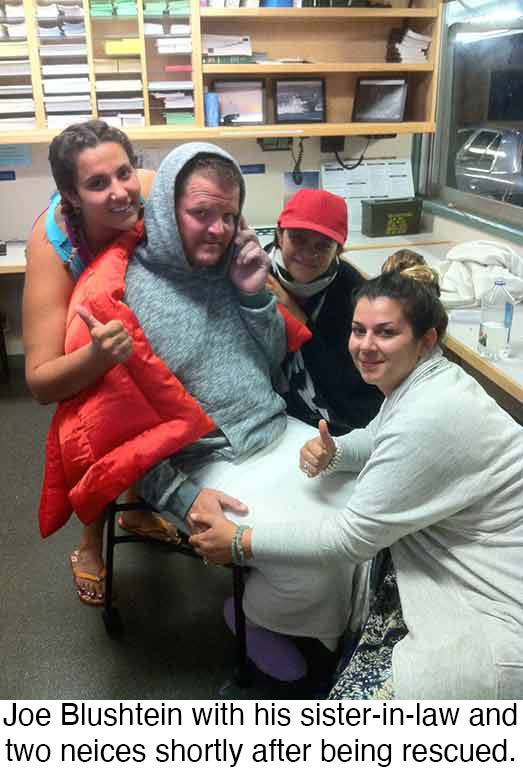
For nearly seven hours Joe was adrift at sea before being rescued by the Coast Guard. Through the night he prayed to god to be rescued, and as Joe tells his story, his prayers were answered. “This truly was a miracle I survived…God gave me the strength and mind to survive. God gave me a second chance.”
Joe’s rescue was not miraculous. Joe was rescued because of decades of dedicated service by the United States Coast Guard’s lone oceanographer, Art Allen. Allen was hired by the Coast Guard to help them figure out how to spot people lost at sea. From a helicopter a thousand feet above the water, or from the deck of a boat a few hundred feet away, you can be looking right at someone that is frantically waving and trying to get your attention, but still not see them. Allen realized that the real problem was not how to see better, but knowing where to look. The more you can reduce the search area, the chances of locating someone lost at sea increase dramatically.
Allen set to work studying how different kinds of objects drift. He gathered data the coast guard already had from its long history of search and rescue. He invented special buoys that the Coast Guard set adrift to get additional data, and then in 1999 he published his findings in a 350 page government report with the exhilarating title, “Review of Leeway: Field Experiments and Implementation”. The implementation part included models that could be used to locate people adrift in the ocean. Allen then worked to disseminate the information and teach search and rescue teams to use the models.

Allen’s scientific research and the models he generated were a revolution in search and rescue. All over the world people began using his models, and the likelihood that someone lost at sea would be found in time to save their life went up by orders of magnitude.
But Allen’s work was not finished. Just a couple years later, in 2001, he was invited to a search and rescue operations center in Virginia to see his models at work. The night he visited an unexpected weather front moved in resulting in an unusually high number of rescue calls. He watched as the team coordinated rescue, after rescue, several times successfully using Allen’s model to predict the location of lost souls. But as the night wore on and the team fatigued, there was one rescue that failed. A family’s sail boat had capsized, and while the father survived, by the time they were found, his wife and daughter had died from hypothermia.
Allen thought that if the computations required to use his models were easier and took less time, that family might have been saved. What they needed was software that could do the calculations. Allen was an oceanographer, not a computer programmer, but that didn’t stop him. He led a team to develop software that could have saved that family, and in 2007 the Coast Guard launched SAROPS 1.0: the first version of the Search and Rescue Optimal Planning System software. Allen once again went around teaching Coast Guard teams to use the new system.
One night, not long after the launch of SAROPS, an inebriated 35-year old man fell off a Carnival cruise ship 30 miles east of Fort Lauderdale, Florida. They had a pretty accurate location for where he fell into the ocean, and thanks to video from the ship, they knew what he was wearing and about how big he was. They put all of this information into SAROPS along with the current ocean conditions, and it spit out a location, and the man was quickly rescued. Had the incident happened just a few months earlier, before the launch of SAROPS, the drunk man most likely would have drowned before being found.
“It is always our helicopter and boat crews that get the lifesaving medals, the awards and pictures in the paper,” said Jennifer Conklin, a Honolulu-based search and rescue specialist who has worked with Allen for more than a decade. “But the guy who makes sure those people get there to save the lives is Art. From his cubicle in New London, Connecticut, his work and expertise have been absolutely critical to actually putting our resources in the right place at the right time.”
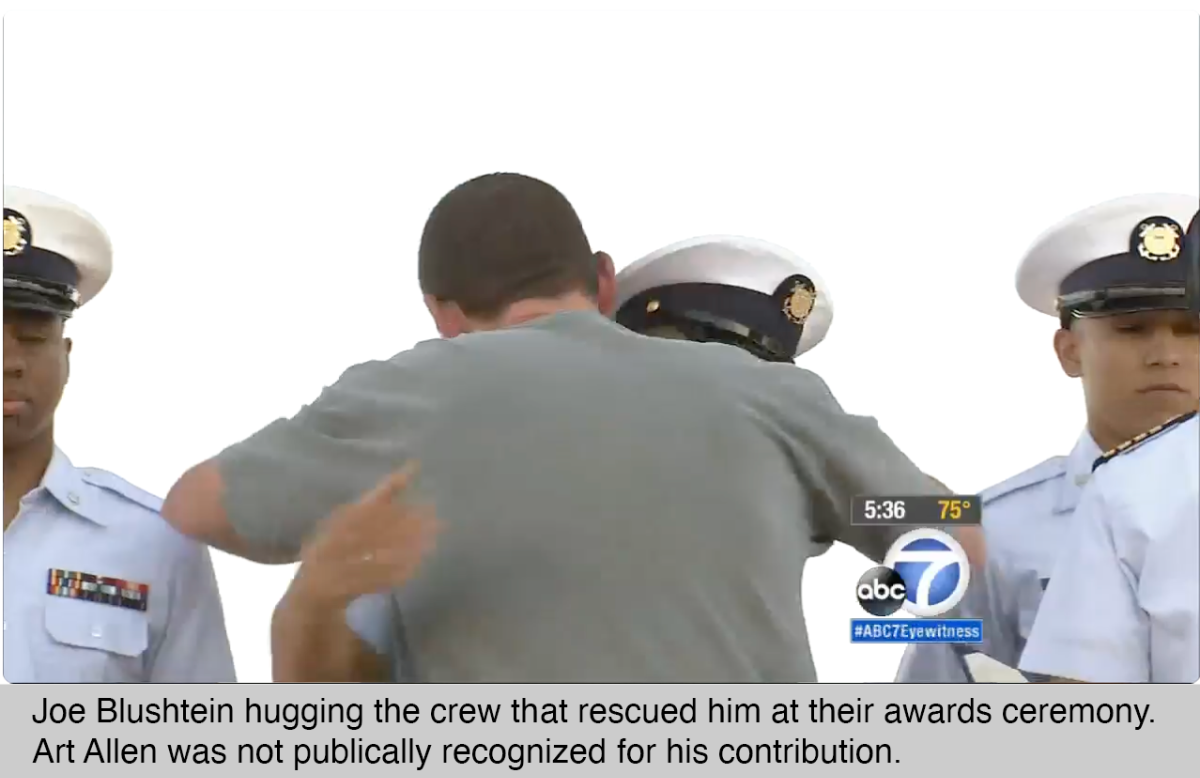
Six months after Joe Blushtein was rescued, he attended an awards ceremony for the crew that rescued him. By sheer coincidence Art Allen was in Long Beach that day, and so attended the ceremony. Allen did not receive a reward. He had not been specially invited. He was not publicly recognized for his contribution. Joe probably had no idea who Allen was, or that the miracle he attributed for his rescue was actually the result of Allen’s work and research. But one of the Coast Guard officers that was there and had worked with Allen for many years leaned over to Art and said, “Good job.”
Art Allen’s story is told in the afterword of Michael Lewis’ 2018 book The Fifth Risk—a book about the transition, or lack thereof, from the Obama administration to the first Trump administration. It is a book that includes inspiring stories, like that of Art Allen, but is mostly an infuriating tale of the arrogance, foolishness and incompetence of the philistines who took over the government in 2017 without the slightest understanding or curiosity about what the government actually does and why it matters. And they learned nothing in their four years in power, except perhaps how to be even more destructive in their second go around.
In 1986 Ronald Reagan famously said, “The nine scariest words in the English language are, ‘I’m from the government and I’m here to help.’” That disgusting lie is emblematic of the decades-long smear campaign that has successfully convinced too many in our country that the federal government is populated by lazy, stupid, wasteful bureaucrats, and we’d be better off without them. Having worked for the federal government, I can attest that there are, in fact, some people that are lazy, stupid, petty and wasteful—just as there are in any organization. But I can also attest that the vast majority of people that I worked with are dedicated public servants who chose to serve from a patriotic sense of duty, and who make our lives better in innumerable ways that most of us will never know.
That is the lesson Michael Lewis learned in writing The Fifth Risk, and what inspired him to write and edit his latest book, just published in March, Who is Government? The Untold Story of Public Service. The new book collects more stories of extraordinary public servants–people who are paradigmatic exemplars of this month’s humanist commitment, “Service and Participation.” Service and participation means putting values into action in ways that positively impact our communities and society as a whole.
We need to tell these stories, promote public service, and push back against anyone that would propagate the lie that those who have chosen lives of service are anything but patriots. And we have to stand up against the evil at work in the current regime. Russell Vought, Senate confirmed director of the Office of Management and Budget, acting head of the Consumer Financial Protection Bureau, and a key architect of Project 2025, was recorded saying:
“We want the bureaucrats to be traumatically affected. When they wake up in the morning, we want them to not want to go to work because they are increasingly viewed as the villains... We want to put them in trauma.”
Thousands of public servants have been fired, pressured to retire, and generally terrorized to purge anyone who might put service to our country above loyalty to the regime. Vital services are being gutted by the so called Department of Government Efficiency (DOGE), led by Elon Musk. For example, as of April, 22,000 IRS employees have accepted resignation offers, and up to 25,000 total staff cuts are anticipated, representing around 25% of the agency’s workforce. The regime has also rolled back nearly all the additional funding provided to the IRS under Biden’s 2022 Inflation Reduction Act.
These cuts will have short-term savings, but that is dwarfed by the projected loss of revenue. Economists estimate that the IRS will collect $8.3 billion less in tax revenue next year due to reduced staffing, resulting in a net loss of $6.8 billion for the federal budget in the first year alone. Over a decade, the cumulative shortfall in uncollected taxes could reach $159 billion, according to projections from the Budget Lab and other budget analysts.
Destroying federal agencies and chasing away talented, dedicated public servants will not improve efficiency, and is not likely to save money. To illustrate the point, let’s return to the case of Art Allen. In telling his story I focused on the thousands of lives saved. According to Michael Lewis, the best place to be lost at sea is the United States because no other country puts as much effort into rescuing its citizens–a value-based service provided by the federal government. But that effort comes at a cost. The Coast Guard cannot say precisely how much money Art Allen’s work and SAROPS have saved, but every hour trimmed from search times saves an average of $60,100. The Coast Guard conducts, on average, 13 searches every day. If Allen’s work shaved one hour off each of those searches–and the actual impact is likely more than that–the work of just one exceptional public servant has saved the taxpayers $285 million dollars a year.
Not every federal employee will have the impact of Art Allen, but the point Lewis has made in writing is that as soon as you actually start to look, unsung heroes in public service are not hard to find. Lewis didn’t choose to tell Allen’s story because it stood out from others, but because he was the first name on an alphabetical list of honorees for the Service to America medals. You can find many more extraordinary stories like this on the website for those honors: https://servicetoamericamedals.org/
These people should be honored and emulated…not vilified and traumatized. And the service that each of us can provide to our country is to take a stand for public service. If you know or encounter anyone that works for the federal, state or local government, thank them for their service and tell them you stand with them in these trying times. Tell your elected representatives that you support government workers, and ask them to stand up to defend them. We must not tolerate the denigration of patriots in public service.